
Selecting aluminum for a chamber component comes down to three questions: which alloy, which temper it is supplied in, and how the goods are classified when they ship. This guide covers the full comparison of 6061, 5083 and 5052, why the temper is settled rather than chosen in semiconductor work, and the commercial case for buying material and first-operation machining from a single supplier.
The Temper: T651 Is the Standard, Not a Choice
T6 and T651 have essentially the same mechanical properties. The difference is residual stress. T651 is solution heat treated, stress-relieved by stretching, then artificially aged; T6 has no stress-relief step. On a chamber body machined from a 200 mm plate down to a 60 mm wall, that difference decides whether the part stays flat. In semiconductor work the answer is therefore settled: plate is specified in T651 as standard practice. T6 is a general-industrial temper, and the trade-off between the two belongs to work where the distortion tolerance is looser and the plate premium is a live commercial variable.
• T651 is the default for any semiconductor part machined from plate, because dimensional stability is a functional requirement rather than a cost item.
• There is also a hard limit on the temper itself. T651 is made by stretching, and beyond roughly 260 mm there is no stretcher that will take the plate. Above that thickness T651 cannot be supplied, and the design has to absorb the movement instead.
• The T6 trade-off belongs to general industrial work — thin parts, brackets, lightly machined components — where the distortion tolerance is generous.
6061 vs 5083 vs 5052 for Chamber Components
| 6061-T6 / T651 | 5083-H116 | 5052-H32 | |||
| Family | Al-Mg-Si, heat treatable | Al-Mg, non-heat-treatable | Al-Mg, non-heat-treatable | ||
| Ultimate tensile strength | 290–310 MPa | 317 MPa | 228 MPa | ||
| Tensile yield strength | 240–270 MPa | 228 MPa | 193 MPa | ||
| Copper content | 0.15–0.40% | ≤0.10% | ≤0.10% | ||
| Thermal conductivity | ≈152 W/(m·K) | 121 W/(m·K) | 138 W/(m·K) | ||
| Corrosion resistance | Good | Excellent — seawater and industrial chemicals | Excellent | ||
| Mg-sensitisation temperature limit | Not applicable | ≤65 °C recommended | Not applicable | ||
|
Moderate | Good | Excellent | ||
| Weld strength retention | Low (≈165 MPa as-welded) | Highest of the non-heat-treatable alloys | Good | ||
| Typical chamber role | Bodies, plates, frames, machined structure | Wet process, chemical exposure, welded vessels, cryogenics | Gas panels, fluid lines, covers, liners, cold plates |
Where Each Alloy Is the Wrong Answer
6061 is wrong where the surface faces an aggressive process environment and copper contamination is controlled — it contains 0.15–0.40% copper — or where the part is a large welded vessel that cannot be post-weld heat treated.
5083 is wrong above roughly 65 °C. There the magnesium-rich β-phase precipitates along grain boundaries and stress-corrosion susceptibility rises sharply. Wet benches and chemical lines are well inside the limit; heated pedestals and bake-out zones are not.
5052 is wrong for load-bearing bodies and base plates. At 193 MPa yield it cannot deliver the stiffness and flatness a machined chamber structure requires.
Material detail behind these boundaries is in 6061-T6 composition and properties,5083 properties and the 65℃ service limit and 5052 properties and formability.
The Commercial Case: Material and Rough Machining from One Supplier
MIANDI METAL GROUP is an aluminum stock supplier for the semiconductor equipment industry that also runs first-operation machining. The purpose is not to compete with your machine shop — it is to remove cost that has nothing to do with your process capability.
Lead time
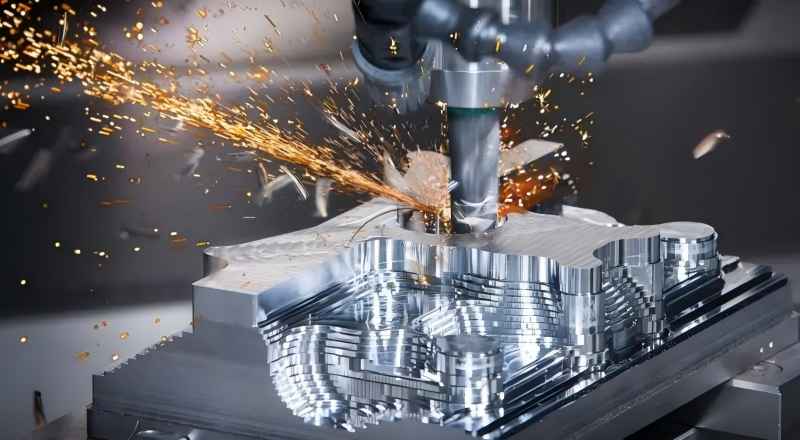
A chamber body normally travels: mill → distributor → your shop → roughing → your shop → finishing. When material and first operation come from one supplier, the plate is drawn from stock and roughed down before it ships, so the roughing cycle leaves the critical path and you receive a near-net blank instead of a 2-tonne plate.
HS classification: the December 2024 export rebate change
China’s Ministry of Finance and State Taxation Administration issued Announcement No. 15 of 2024 on 15 November 2024, effective 1 December 2024, cancelling export tax rebates on aluminium and copper products. Attachment 1 of that announcement lists the affected commodity codes, and the aluminium entries are mill products — the semi-finished forms a metal trader ships:
• 7604 — aluminium alloy bars, rods, profiles and hollow sections
• 7606 — aluminium plates, sheets and strip over 0.2 mm thick, including 7606.12.90 (aluminium alloy rectangular plate and sheet over 4 mm thick) — the code covering chamber-body plate stock
• 7607 — aluminium foil
• 7608 — aluminium tubes and pipes
• 7609 — aluminium pipe fittings
Once the metal is machined into a component it is classified as an article rather than as a semi-manufactured material. The article classification does not appear on the cancelled list, so the same aluminium shipped as plate and shipped as a rough-machined part does not carry the same customs treatment — and the classification of the exported goods is the input to the rebate calculation.
That difference is the whole commercial case for buying material and first-operation machining together. An exporter of aluminium plate carries the metal, the freight and the tax treatment of a raw material. An exporter of a finished component does not. A supplier who only trades material cannot offer this, because there is no component to classify.
Compliance note. Classification is determined by customs on the basis of the actual goods, their principal function and the tariff schedule in force at the date of export. Rebate eligibility is a customs determination, not a supplier representation. Confirm the applicable code and rate with your customs broker or the local customs authority before building a cost model on it. Nothing in this article is tax or customs advice.
Chips, offcuts and scrap recovery
Rough machining generates most of a chamber body’s scrap by weight, and converting a plate into a near-net blank removes 40–70% of the shipped weight. Doing the first operation at source therefore captures the scrap value — worth more here than in most export destinations — the freight on metal that would have been cut away anyway, and the roughing cycle time.
What we deliberately do not do
We do not quote finish machining, tight-tolerance features or anything that carries your process IP. We supply sawed, milled or turned near-net blanks with an agreed machining allowance, deburred and dimensionally inspected.
Frequently Asked Questions
Should I order T6 or T651? For semiconductor work the question does not arise: plate is specified as T651 as standard, because dimensional stability after heavy machining is a functional requirement. T6 is a general-industrial temper, and the trade-off between the two belongs to work where the distortion tolerance is looser.
Can a welded 6061 chamber body hold its tolerances?Mechanically, if it is designed against the 165 MPa as-welded allowance. Dimensionally, only if the machining sequence is planned around the weld — weld first, then stress-relieve or semi-finish, then finish.
Does buying rough-machined blanks instead of plate change the HS code? It can. Aluminium plate and sheet over 0.2 mm thick — including 7606.12.90 for rectangular alloy plate over 4 mm — sits on the cancelled-rebate list under Announcement No. 15 of 2024 from 1 December 2024. Once the metal is machined it is classified as an article instead, and the two do not carry the same export treatment. Confirmation belongs with your customs broker.
Get a Quotation
Send your drawing, the alloy and temper, the plate thickness you are considering, and your destination port. MIANDI METAL GROUP will come back with material plus first-operation rough machining as a single line item, with grade, mill certificate and machining allowance stated up front.
Post time: Oct-08-2026